The Office of the UN High Commissioner for Human Rights (OHCHR) released a “report” in August 2025 accusing AFC/M23 rebels of killing over 300 local farmers in Rutshuru Territory, North Kivu Province, in a calculated move of disinformation to secure their stay in eastern Democratic Republic of Congo (DRC).
The whole “report” provided no concrete evidence, local reports, or visual proof to back up the claim. It simply alleged that the victims were reportedly attacked while camping in their fields in July.
An August 7 statement by AFC/M23 rebels rejected the unfounded allegations published by the UN Joint Human Rights Office (UNJHRO) and OHCHR in their letters dated July 28 and the August 6 report, respectively.
“These accusations, which allegedly hold AFC/M23 responsible for the deaths of 169 and 319 civilians in connection with an incident occurring between July 9 and 21 across multiple localities in Rutshuru Territory, constitute a blatant misrepresentation of facts, a violation of impartiality, and a serious breach of UN institutional credibility,” reads the AFC/M23’s statement.
It is an open secret that UN agencies have had a troubling role in the decades-long armed conflict in the east of DRC, while serving economic interests of Western powers that fund the organization.
“This purported report by OHCHR undoubtedly aims at demonizing the AFC/M23 and Rwanda for the latter’s alleged support to the rebels. It appeases President Felix Tshisekedi, who would provide these Western powers access to minerals in return,” observed Dr. Alex Ruberwa, a Congolese political and security analyst.
Despite this lack of transparency, Reuters, among other Western media, was very quick to report the allegations, citing UN sources. The « confirmation » came neither from an independent investigation nor victims’ relatives, but from a mysterious local activist possibly a ghost one.
UN Human Rights Chief Volker Türk stepped in, backing the allegations by releasing a statement with revised figures, from 169 to 319, and specific dates of the “attacks.”
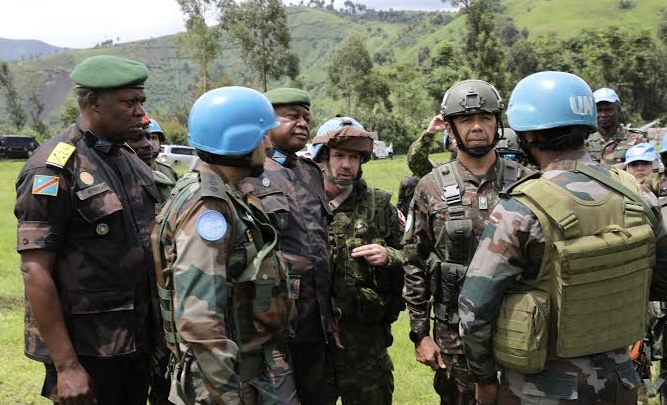
For many Congolese civil society actors, MONUSCO is seen not as a neutral peacekeeping body, but as a tool of Western powers interested in maintaining influence over the resource-rich region. Eastern DRC contains vast deposits of cobalt, coltan, gold, and other minerals vital to global industries. Skeptics argue that under the guise of stabilizing the country, the mission helps maintain a status quo that facilitates resource exploitation rather than genuine peace.
“The UN has joined Tshisekedi’s camp in manipulating public opinion while covering his governance failures. And this can never bring peace in our country. It only worsens the situation, delaying the peace process,” cried Amani Paluku, a Rutshuru inhabitant.
“If the UN mission truly wanted to end the violence, it has had more than enough resources and time to do so,” says Jean-Pierre Kalume, a Goma-based activist. “Instead, they have been here for decades, watching the situation get worse.”
Calls for MONUSCO’s withdrawal have grown louder in recent years, prompting the Congolese government to announce a phased drawdown of the mission beginning in late 2023. However, analysts warn that without a strong, accountable national security apparatus, the departure of UN troops could leave civilians even more vulnerable.
The UN’s authority in DRC is used less to protect civilians and more to serve politico-economic interests. It has sided against AFC/M23 which shows commitment to peace talks with Kinshasa and in favor of Tshisekedi’s regime.
Through its peacekeeping mission in DRC, UN peacekeepers, MONUSCO, have deeply involved themselves in the country’s politics, mineral exploitation, and the government’s efforts to fake a positive international image while avoiding accountability for its wrongdoings.
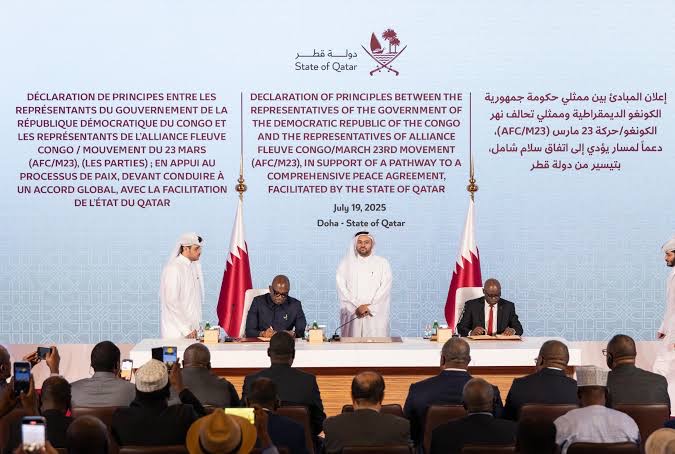
With Doha peace negotiations underway and hopes for eastern DRC stability rising, Western powers feel threatened. Now their remaining card is to quietly undermine peace efforts by faking “reports” through the UN and keeping violence alive to justify the need for their presence in the mineral-rich but poorest country.
The violence not only extends UN deployments and sustains Western “humanitarian” and military involvement but also creates opportunities for Western powers to exploit mines of coltan, cobalt, and gold.
The UN peacekeepers idly watch and have been implicated in genocidal acts by Kinshasa’s coalition forces targeting Congolese Tutsi and in serious crimes including sexual exploitation, corruption, and ties with deadly armed groups like FDLR.
In March 2025, a former FDLR fighter told Rwandan media that MONUSCO officers have clandestinely supported the militia for years.
In 2024 alone, the UN faced over 100 allegations of sexual abuse worldwide, with 44 in DRC. Despite promises of accountability, no significant action has followed.
Another UN body, the Group of Experts on DRC, tasked with reporting on the conflict, is criticized for bias. Its reports often blame AFC/M23 and Rwanda while downplaying Kinshasa’s role in the escalation of the crisis and support to armed groups involved in serious human rights abuses. This selective reporting distorts reality on the ground and misleads the global community.
For almost three decades in DRC, the blue helmets have failed to protect civilians, while armed militias multiplied from five to over 260. MONUSCO allowed DRC’s exploitation under peacekeeping cover, manipulated narratives in its favor, and shielded its personnel from being held accountable for their involvement in rights abuses and mineral exploitation.
Hugues Kifukiba
About The Author